Web Research Services
The world of online research is undergoing a massive transformation. Traditional search engines, once the gateway to all information are now slowly becoming outdated as AI begins to take over the research process. Businesses today no longer need just “results.” They need synthesized insights, context, and actionable intelligence. This shift is giving rise to the future of web research services, where AI-powered tools, autonomous research agents, and knowledge graphs play a central role.
As companies look to stay competitive, the demand for advanced web research services is growing fast and AI is the primary driver behind this evolution.
The Shift from Search Engines to AI-Driven Research
Before exploring how AI will replace traditional searches, it's important to understand why this shift is happening. Traditional search engines excel at finding information, but they weren’t designed for deep, analytical reasoning.
Businesses need clear answers, not endless pages. AI bridges this gap by turning scattered online data into structured, meaningful insights used across various types of web research service needs.
Why Traditional Search Is No Longer Enough?
- Search engines provide links, not insights
- Endless filtering is required to separate useful information from noise
- Limited support for context, reasoning, or synthesis
- Difficult for businesses to conduct in-depth market or competitor research
How AI Is Reshaping the Web Research Landscape?
AI systems don’t just search, they read, understand, analyze, and summarize
AI agents can work autonomously to perform tasks that previously required human researchers
Results are delivered as insights, not URLs
AI reduces research time by up to 70%, boosting business decision-making
What Are AI-Powered Web Research Services?
AI-powered web research services go beyond keyword-based search. They use machine learning, natural language processing, knowledge graphs, and reasoning models to deliver structured answers, not random search results.
These services are now offered by modern web research service providers who combine human intelligence with AI systems to ensure credible research outcomes.
Understanding the Difference Between Search and Research
Search = Find web pages
Research = Find answers
AI Research = Understand questions, scan the web, extract insights, and deliver clear conclusions
How Modern AI Tools Go Beyond Keywords?
Modern AI tools go far beyond keyword matching by understanding the intent, context, and relationships behind a query. They scan multiple sources at once, compare and analyze information, and deliver clear, structured insights instead of just links.
Interpret intent, not just keywords
Pull data from multiple sources simultaneously
Compare, analyze, and synthesize information
Deliver structured insights supported by sources
How AI Is Transforming the Web Research Workflow?
AI is not just speeding up existing workflows—it is rebuilding them entirely. This is one of the biggest content gaps competitors fail to explain clearly.
The old way of research involved manual searching, filtering, analyzing, and compiling. AI automates all of this.
Traditional Research Workflow vs. AI Research Workflow
![]()
Old Workflow | AI-Powered Workflow |
|---|---|
| Run multiple searches | AI research agents understand queries |
| Visit dozens of sites | Automated data extraction from multiple sources |
| Extract data manually | Intelligent synthesis and reasoning |
| Compile insights into reports | Output structured insights with summaries & recommendations |
Speed, Accuracy & Automation Improvements
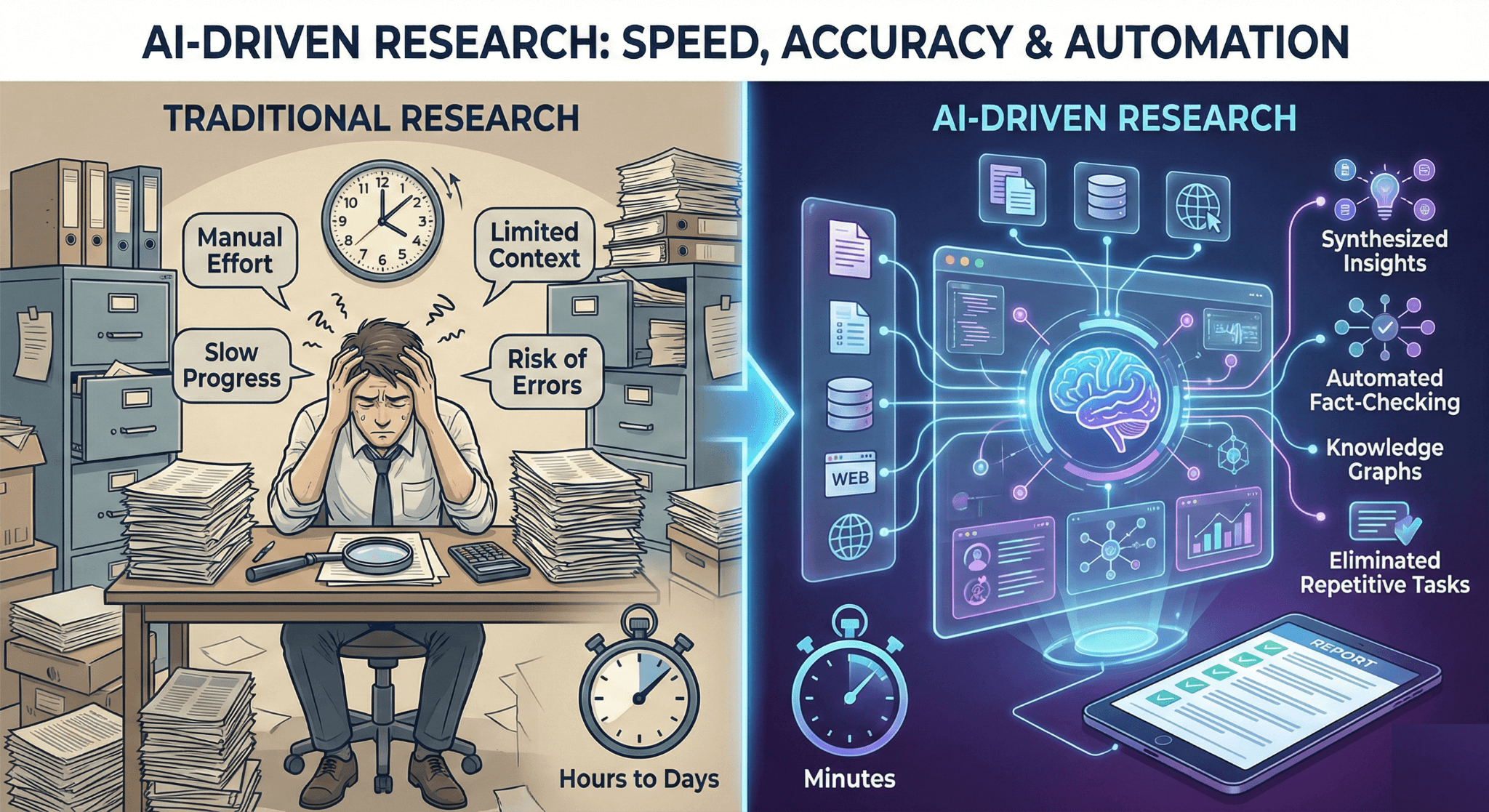
The biggest advantage of AI-driven research is the massive improvement in efficiency, precision, and automation. Tasks that once required a full day of work can now be completed in minutes.
AI performs in minutes what used to take hours: Automated crawling and synthesis rapidly speed up projects.
Improved accuracy through automated fact-checking: AI validates information across multiple sources to reduce errors.
Knowledge graphs reduce duplicate or irrelevant data: AI understands context and relationships, ensuring only relevant insights are included.
Search automation technology eliminates repetitive tasks: No more manual searching, clicking, filtering, or copying data—AI handles it all.
AI Research Agents — The Future Beyond Traditional Search Engines
This is a key competitive content gap—few providers explain how autonomous research agents actually work.
AI research agents act like digital analysts. They can interpret tasks, collect data independently, evaluate information, and deliver answers on their own.
What Are Autonomous AI Research Agents?
Crawl the web for relevant information: They scan articles, databases, reports, and public sources automatically without needing repeated searches.
Perform real-time data analysis: AI analyzes data instantly, identifying patterns, trends, and key insights as it collects information.
Compare sources for credibility: It evaluates multiple sources, cross-checks facts, and filters out unreliable or duplicate information.
Generate insights and summaries: Instead of links, AI produces readable summaries, insights, and conclusions tailored to the research goal.
Work continuously without supervision: Once activated, agents operate autonomously—running tasks, updating information, and refining results nonstop.
How They Replace Traditional Search Engines
No need to run multiple searches
Results are delivered as structured reports
They understand context, intent, and complexity
They combine multiple data points to produce insights
Checkout our detailed Web Research Guide to understand the types and best methods.
How Automation Is Revolutionizing Web Research Services?
Automation is becoming the backbone of modern web research, enabling faster, more accurate, and highly scalable insights. Instead of manually searching, collecting, and organizing data, automated AI systems handle these tasks instantly and continuously. This shift allows businesses to access near real-time information without the repetitive, time-consuming processes of the past.
What Automation Brings to Web Research
Continuous data collection: Automated tools gather updated information around the clock without human involvement.
Instant filtering and organization: Automation removes noise, duplicates, and irrelevant data before analysis begins.
Real-time monitoring: Businesses can track competitors, trends, or markets with live insights.
Scalability at zero extra effort: Automation handles thousands of data points—something nearly impossible manually.
Consistent accuracy: Automated systems reduce human error and maintain high-quality research standards.
Where AI Falls Short — And Why Human Validation Still Matters
AI has advanced rapidly, but it still isn’t flawless. Being transparent about these limitations not only builds trust but also highlights why human involvement remains essential in web research. While AI can analyze vast amounts of data quickly, it sometimes misinterprets information or produces inaccurate results without proper oversight.
Risks of AI Hallucinations & Source Gaps
Misinterpret outdated data: AI may pull information that is no longer relevant or updated, leading to misleading conclusions.
Create overly confident summaries: AI often presents answers with confidence even when the interpretation is incomplete or uncertain.
Miss niche or unindexed sources: Important insights hidden in lesser-known or unindexed websites may be overlooked by AI systems.
Produce hallucinated answers: In rare cases, AI can generate details that seem factual but are not backed by real sources.
Why Human Validation Is Still Essential
Fact-checking: Humans verify whether the information AI provides is accurate and supported by credible sources.
Bias correction: Analysts identify and correct biases or gaps that AI might unintentionally introduce.
Source credibility validation: Humans review the quality and reliability of sources before using them in research.
Accurate interpretation of complex insights: Some insights require context, experience, and judgment—areas where humans still outperform AI.
How AI-Driven Research Improves Decision Making?
Businesses depend on accurate research to guide strategy, marketing, and operations. AI enhances this process by delivering insights faster, with greater precision and depth. Instead of spending hours gathering information, companies get ready-to-use data that supports smarter and more confident decision-making.
Faster Market, Competitor & Customer Insights
AI rapidly collects and analyzes information from multiple sources, helping businesses understand their environment in real time.
Competitor profiles: Quickly identifies key strengths, weaknesses, and activities of competitors.
Customer sentiment: Analyzes online feedback and reviews to reveal customer needs and concerns.
Industry datasets: Compiles statistics and research from credible sources.
Market trends: Tracks emerging patterns and opportunities.
Product comparisons: Evaluates features, pricing, and performance across multiple products.
AI-Powered Data Extraction for Smarter Strategy
AI’s intelligent data extraction provides insights that are:
Actionable: Clear takeaways that support immediate decision-making.
Structured: Organized information that’s easy to understand and use.
Verified: Cross-checked using multiple sources to ensure accuracy.
Tailored: Customized to fit the specific goals or questions of the business.
Future Trends (2025–2035) & How Businesses Can Prepare for AI-Driven Web Research
AI will not just improve web research—it will completely reshape how businesses access insights over the next decade. Search engines will gradually evolve into “answer engines,” delivering instant, synthesized responses instead of long lists of links. Companies can expect more personalized insights and multimodal research, where AI can analyze text, videos, audio, and visuals together for deeper understanding.
How AI Will Shape the Next Decade?
Instant synthesized answers: Search engines will provide complete explanations instead of directing users to multiple pages.
Personalized insights: AI will tailor research outputs based on user roles, industries, or business needs.
Multimodal analysis: AI will interpret information from text, videos, images, and audio for richer insights.
Autonomous research agents: AI tools will independently run research tasks, track updates, and collaborate with teams.
Predictive insights: Using pattern recognition, AI will forecast market or competitor trends before they happen.
These shifts represent the core future trends in AI-driven web research services.
How Businesses Can Prepare for an AI-Driven Research Future?
To stay competitive, businesses must adapt their teams, tools, and workflows to work effectively with AI.
AI literacy: Teams should understand how AI research tools work and where they are most beneficial.
Tool and workflow adoption: Integrating AI tools into daily research processes will streamline operations.
Bias detection & validation: Teams must learn to cross-check AI outputs and ensure reliability.
Critical interpretation: AI provides insights, but humans must still apply context and judgment.
When choosing AI-powered research tools, companies should look for:
Accurate and verified data
Transparent sourcing
Automated, ready-to-use insights
Seamless integration with existing business systems
Businesses that adopt these tools early will significantly outperform competitors relying on outdated, manual research methods.
Contact Us for the Image Annotation Services
 Contact Us
Conclusion
AI won’t just enhance web research—it will fundamentally redefine it. As autonomous AI agents take over data extraction, synthesis, and reasoning, traditional search engines will gradually shift into supporting roles. However, human intelligence will continue to play a critical part in validating insights, correcting biases, and making strategic decisions that AI cannot fully replicate.
As demand grows for deeper, faster, and more reliable insights, businesses will increasingly depend on advanced web research services that combine the speed of AI with the accuracy of human oversight. Companies that choose to outsource web research services will gain a competitive edge by accessing scalable expertise and AI-powered intelligence without expanding internal teams.
The future of web research is already unfolding—and organizations that adopt AI-driven research today will lead the markets of tomorrow.